Friday, 31 July 2009

A small arrival of waders was noted today with single Ringed Plover, Dunlin and Sanderling noted. The wind and rain kept most observers indoors and the few that did venture out did so for little reward.

Two White-line Darts, a Herald and an Endotrichia flamiliaris were caugh overnight in the moth traps.

Fulmar

Gannets

House Martin

Young Wheatear

Turnstone

All pictures (c) Steve Stansfield

Thursday, 30 July 2009

A rather quite seawatch was brightened up when three Little Egrets flew south and then landed in Solfach. They then spent the rest of the day commuting between Solfach and Henllwyn. It is surprising that even though Little Egret is a common bird in most of the UK these days and that they even breed in Gwynedd, there have been just 15 previous records on the island, though there have been records now for six consecutive years.

Little else of note was seen as most of yesterday's warblers had moved on.


Little Egrets
(c) Ben Porter

Wednesday, 29 July 2009

An arrival of migrants today produced a minimum of 56 Willow Warblers on the island, along with the first two Common Grasshopper Warblers of the autumn, seven Sedge Warblers and a Green Sandpiper.

Tuesday, 28 July 2009


A very wet and windy day produced little other than about 1000 Manx Shearwaters passing at sea.

A Brown-line Bright-eye was trapped in the moth trap at Nant along with a Poplar Hawk Moth.
Brown-line Bright-eye
(c) Steven Stansfield

Monday, 27 July 2009

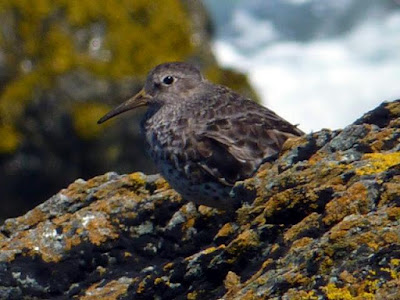
A rather early returning Purple Sandpiper, first seen yesterday, was still present on the island today along with the increasing flock of Turnstones. Six Willow Warblers were at Nant, but very little else of note has been seen.

Staff holidays are the reason for the lack of post over the past week, though an 'normalish' service has now resumed. Rich E will be back on Sat 1 Aug and Rich B a week later.

Purple Sandpiper on Henllwyn
(c) William Hemmens

Evening sunset
(c) William Hemmens

Friday, 17 July 2009

A strong wind had picked up by the morning, making seawatching look like the most likely activity to produce a good bird. Disappointingly, although many birds were passing close offshore throughout the day, they were virtually all Manx Shearwaters with nothing scarcer amongst them. On the land, Eurasian Curlew numbers had risen again to 40, and a Common Swift flew north.

Thursday, 16 July 2009

A very small amount of hirundine passage appeared to be in progress during the morning, with two Sand Martins passing through with a handful of Barn swallows. Otherwise, the only bird of note was a Grey Heron.

A trip to the nearby Gwylan islands to ring Atlantic Puffin chicks proved to be a bit too late – frustratingly, not a single burrow was found to be still occupied.

The second ever Southern Wainscot for the island was the highlight from the moth trap, while in the absence of puffins, a Dark Spinach moth was the best find on the Gwylans.


Southern Wainscot (c) Richard Else

Wednesday, 15 July 2009

In pleasant weather a Ringed Plover was easily the most interesting bird of the day, comfortably beating a distant Black-headed Gull into second place. The House Martins nesting at the lighthouse were surprisingly back in attendance after being apparently absent for several weeks.

Common Field Grasshoppers - the only species of grasshopper on Bardsey - are now appearing all over the island as adults, having completed their four juvenile instars, and should be beginning to sing in the next few days.

Photograph (c) Richard Else

Tuesday, 14 July 2009

A curate’s egg of a day had its glorious sunny spells, but the next severe shower was never far away and, when out in the field, a wary eye had to be kept on the horizon for menacing signs of imminent precipitation. Between downpours it was safely established that no great influx of birds had taken place; in fact, not a single new bird was seen all day. The Eurasian Collared Dove, 11 Common Redshanks and the two Whimbrels were still around from earlier in the week.

The moth trap contained few insects of note, but a startling discovery was a European Robin sitting quietly under the egg boxes at the bottom of the trap – and then making a sudden bolt for freedom as its hiding place was removed! Whether or not the bird was responsible for the lack of moths was not entirely clear.

Monday, 13 July 2009

A showery day without much of interest. A Eurasian Collared Dove and a couple of Black-headed Gulls were the only new birds, while two Whimbrels, the Common Sandpiper and a Grey Heron remained.

A Burnished Brass caught in the moth trap was the first of this species on the island for a few years. An absurdly minute micro-moth was also found during the day, and has been identified as one of a number of very similar Leaf Mine species of the genus Stigmella.


Stigmella sp. (c) Richard Else

Sunday, 12 July 2009

After a tempestuous night, the weather brightened to leave a day that was perfectly sunny, although still rather breezy. As with the previous day, bird movement seemed to be restricted to a few waders. This time Common Redshanks were the most numerous, with 11 around the Narrows. A Common Sandpiper was again present, as were two Grey Herons, a Whimbrel, four Eurasian Curlews and the Common Starling.

Saturday, 11 July 2009

The only different birds to have arrived were waders: 14 Dunlins and a Common Sandpiper were on the beach early in the morning. The two Whimbrels, eight Eurasian Curlews, a Grey Heron and the Common Starling remained.

An early Northern Eggar moth was on the wing around the hillside in the afternoon.

Friday, 10 July 2009


A perfectly calm morning seemed to have brought a handful of migrating oddments to the island: a Tree Pipit was seen near the lime kiln in the morning, a Grey Wagtail flew over, a Common Kestrel was hunting over the lowlands and a single Common Starling was observed associating with a family of Common Stonechats. On the coast, three Grey Herons and two Whimbrels were with 14 Eurasian Curlews and four Common Redshanks.

A Dingy Footman caught in the moth trap in Cristin Withy was only the third ever seen on the island.


Scarce Footman (left) and Dingy Footman (c) Richard Else

Thursday, 9 July 2009

At least one, quite possibly two Whinchats had arrived on the island early in the morning; perhaps failed breeders already on their way back south. No other new birds were seen until the evening when a Common Crossbill, the first one this year, appeared in Ty Nesaf garden.

The first Grayling butterflies of the summer were found during a walk along the mountain ridge in the sunshine, as well as the usual selection of migrant moths. The highlight from the moth trap was a Phlyctaenia coronata, an attractive pyralid not recorded on the island for some years.


Phlyctaenia coronata (c) Richard Else

Wednesday, 8 July 2009

With a good breeze blowing in the morning, a hopeful session in the seawatching hide seemed like a good idea. A couple of Sandwich Terns were the most notable seabirds seen, but an unexpected adult Eurasian Hobby flying south at sea more than made up for the lack of other species. A Common Greenshank flying around over the Narrows was another surprising sighting, and an addition to the island year list. Another good record was an Arctic Skua in the Bardsey Sound, seen from the boat bringing visitors across to the island. Three Common Redshanks and 28 Eurasian Curlews roosted around the coast.


A good year for moths is of benefit to more than just the island's lepidopterists.

Meadow pipit (c) Ben Porter

Tuesday, 7 July 2009

Virtually nothing of note was recorded during a day that was ornithologically desolate even by the standards of recent days – the dazzling pinnacle of excitement was probably another sighting of the same Grey Heron that has been lurking around the coast for most of the summer.

Plenty of moths were on the wing, but the variety of species was much the same as in the previous days – 15 Six-spot Burnets, 2 Rush Veneers and a Diamond-back Moth being the highlights.
A couple of attractive micro-moths from earlier in the year have both been identified as new species for the island: namely Batia lambdella and Acleris bergmanniana.


Batia lambdella (c) Richard Else


Acleris bergmanniana (c) Richard Else


Monday, 6 July 2009

A ‘redhead’ Red-breasted Merganser found swimming in Henllwyn in the evening was a mild surprise, and undoubtedly the most interesting sighting of the day. At least 100 Northern Gannets spent the day fishing offshore; considerably more than in recent days. A Common Redshank and 11 Eurasian Curlews on the South End were the only other birds worth mentioning.

Highlights from the moth trap included a Snout and the first Dark Sword-grass of the year. A second trap, a big ‘Robinson’ MV type brought by a visitor to the island, pulled in a spectacular 195 Garden Tigers at Nant.


Red-breasted Merganser (c) Ben Porter

Sunday, 5 July 2009

A Common Sandpiper arrived in the morning to join the Common Redshanks and Eurasian Curlews from the previous day. A Eurasian Collared Dove was at the lighthouse and nine Common Scoters and five Black-headed Gulls flew past the island.

A Hummingbird Hawkmoth was seen again around the gardens at the north of the island, as was the first Swallowtail Moth of the year.

Saturday, 4 July 2009

The sodden arrival of the week’s visitors during a lengthy torrential downpour meant that little wildlife was observed for much of the day. After the eventual cessation of the deluge early in the afternoon the weather did improve, but not many new birds were around. Seven Common Redshanks, six Eurasian Curlews and the Grey Heron were around the coast and nine Common Scoters –the first for quite a while – were seen flying by at sea.

Late in the afternoon, the first Hummingbird Hawkmoth of the year was seen feeding in the garden of Ty Bach.

Friday, 3 July 2009

A humid and drizzly night had failed to bring in much in the way of birds, but a new Common Chiffchaff had arrived in the Lighthouse Garden and a Common Redshank was on the beach. A Grey Heron, a Eurasian Siskin and two Redpolls were the only other birds worth a mention.

The muggy and dark conditions during the night resulted in a moth trap that was literally buzzing with the sound of 160
Garden Tigers caught within. Besides the masses of tiger moths, a Drinker was the only real species of note. Lots of day-flying Lepidoptera were recorded when the sun came out, including over 100 Painted Ladies and good numbers of Diamond-back Moths and Rush Veneers.

Some Garden Tigers (c) Richard Else

Thursday, 2 July 2009

Following the single forerunner the previous evening, a total of seven Common Sandpipers were present around the Narrows in the morning, along with a Whimbrel and seven Eurasian Curlews.

A jam-packed moth trap contained a diverse array of 49 different species, the most unusual of which were a Purple Clay and a Sandy Carpet.

Wednesday, 1 July 2009

A Grey Heron and a couple of Collared Doves were the only different birds to arrive during the day. Late in the evening a Common Sandpiper was heard calling during an (ultimately unsuccessful) attempt to catch the Little Owls near Cristin.

The moth trap contained the impeccably-timed first July Highflyer of the year and a smart Archer’s Dart – the latter being yet another addition to the island list.
Archer's Dart (c) Richard Else