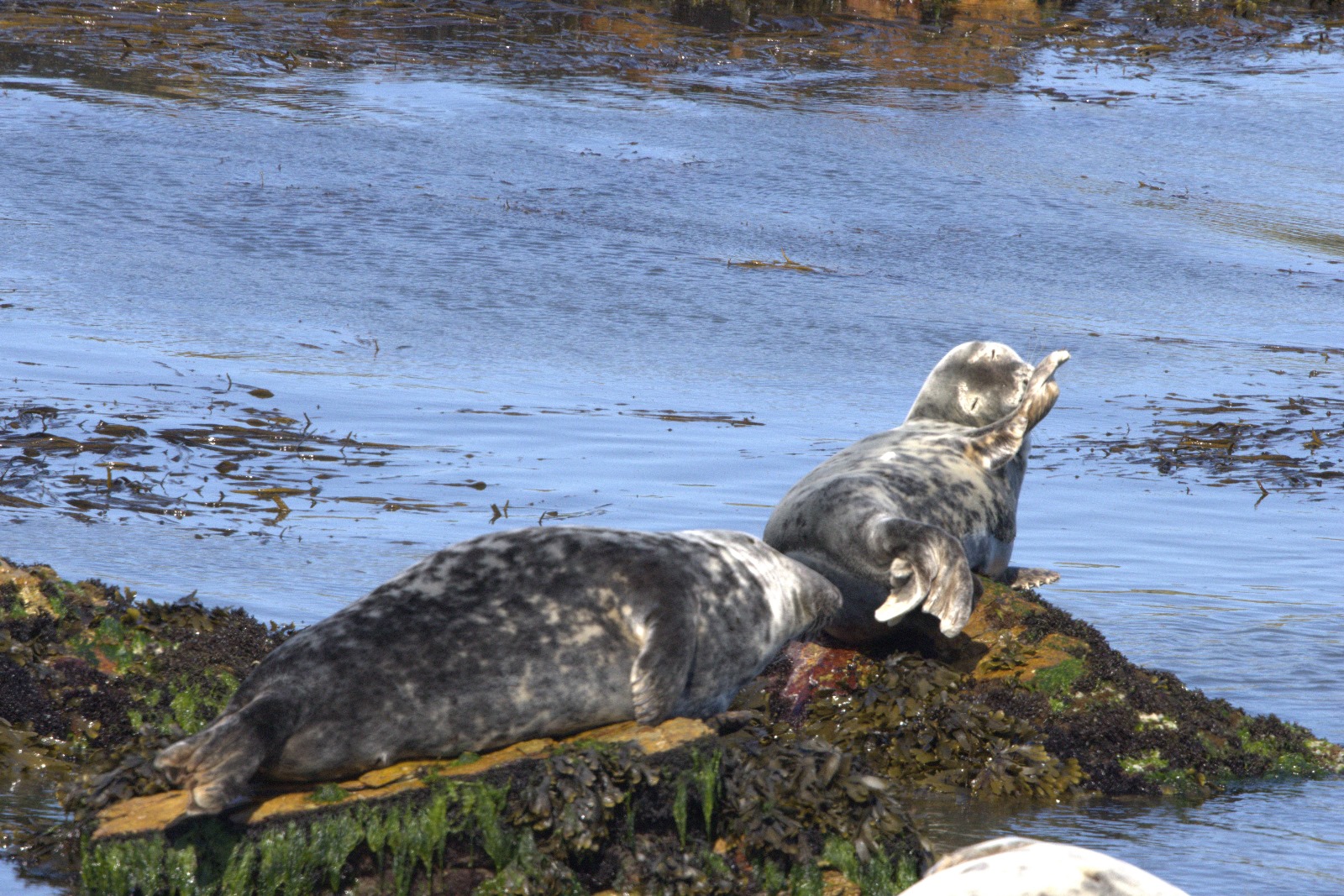
Sunday, 22 November 2009

More strong winds force lots of gulls into Solfach again where a first-winter Little Gull was seen.
Herring Gulls (c) Steve Stansfield

High Seas were lapping the underside of the hide on Solfach giving the feeling we were in a boat! (c) Steve Stansfield

First-winter Little Gull in Solfach
(c) Steve Stansfield

First-winter Kittiwakes
(c) Steve Stansfield

Possible Herring Gull x Glaucous Gull hybrid
(c) Steve Stansfield

Herring Gull
(c) Steve Stansfield

A Water Pipit was also present on Solfach.

Water Pipit
(c) Steve Stansfield

Good numbers of Turnstones were feeding on the beach as well.

Turnstones (c) Steve Stansfield

Friday, 20 November 2009

The weather today was amazingly different from the rest of the week, with no rain and only light winds. A Hen Harrier (only the second one this year) spent the morning quartering the lowlands and three Bramblings were visiting the bird feeders.

Thursday, 19 November 2009

In what must be a contender for some sort of ‘fewest birds seen in a day’ record, the horrendous weather kept most birds – and observers – tucked up out of the way of the gales and heavy rain. A Brambling was, quite literally, the only thing worth mentioning.

Wednesday, 18 November 2009

A very large number of gulls spent the morning in Solfach, feeding amongst the waves that were being blown high up the beach. Herring Gulls were by far the most numerous species, with around 1200 of them milling around, and a small number of Lesser and Great Black-backed Gulls were with them. Further out in the bay a feeding flock of smaller gulls was assembled comprising 400 Kittiwakes, four Black-headed Gulls and a couple of Little Gulls. Not many landbirds were seen, as the conditions forced most of them into hiding for the day, but 40 Chaffinches, eight Goldfinches, two Linnets, a Brambling and a Siskin were visiting the feeding stations, a Reed Bunting remained, and 15 Song Thrushes, ten Blackbirds, two Redwings and a Fieldfare were seen.

Tuesday, 17 November 2009

A confiding and slightly bedraggled Snow Bunting on the west coast was the best bird of the day. A movement of seabirds early in the morning involved around 800 Auks (as usual, most of these were Razorbills) and 400 Kittiwakes, with three Fulmars, a Gannet, 25 Black-headed Gulls and three Common Gulls amongst them. Seven Goldcrests were at Nant, and theBlackcap and three Chiffchaffs were still present. Other passerines seen during the day included one each of Reed Bunting, Siskin, Linnet and Redpoll, nine Goldfinches, six Great tits, 15 Blackbirds, ten Song Thrushes, two Fieldfares and a Redwing. A Buzzard was seen, and the two Kestrels and a Merlin remained.

Snow Bunting (c) Ben J Porter

Monday, 16 November 2009

Two Little Egrets flying north over the island were a surprise, and were easily the highlight of another tempestuous day. A Blackcap and six Chiffchaffs were noted sheltering from the ferocity of the elements, 300 Starlings were counted, and an apparent increase in the number of Song Thrushes, to around 20, made them the most numerous species of thrush on the island; with 17 Redwings, ten Blackbirds and a Fieldfare also present. Raptors included two Kestrels and a Merlin.

Record shot of the two Egrets
(c) Ben J Porter


Sunday, 15 November 2009

Four Fulmars were the highlight of a short seawatch, while landbirds remained in short supply. A Water Rail was at Cristin, three Skylarks and 400 Starlings were in the arable fields, and a couple of Goldcrests and four Chiffchaffs were seen in and around the plantation. Numbers of finches and thrushes remained much the same: two Lesser Redpolls, 40 Chaffinches, eight Goldfinches, 12 Blackbirds, eight Song Thrushes, four Fieldfares and two Redwings.

Moth trapping has pretty much come to an end for the year, as few species are still on the wing this late in the autumn. After a few good additions in 2009, the island’s moth list now stands at 324 species. In a remarkable coincidence, this is exactly the same as the number of birds that have been recorded here.

Saturday, 14 November 2009

There was not much to report after another uneventful day, and it seemed that the autumn had, in terms of bird migration, more or less come to an end. Around 750 Kittiwakes were feeding offshore, along with a couple of Black-headed Gulls and Common Gulls, and 400 assorted Auks flew past. 300 Starlings spent the day on the island, with ten Blackbirds, six Song Thrushes and a Fieldfare. Two Lesser Redpolls, six Goldfinches and 40 Chaffinches were counted and a Merlin was on the South End. A Risso’s Dolphin was seen off the north end of the island.

Friday, 13 November 2009

Very little worth mentioning was seen during another very quiet day. At least four Water Rails were heard squealing, although, as usual, more probably went undetected. A few more finches were counted in the morning, including 60 Chaffinches, 15 Linnets, ten Goldfinches, three Lesser Redpolls, a Brambling and the Bullfinch. 12 Skylarks were in the North West Fields, two Merlins and a Sparrowhawk were seen hunting and 200 Starlings were feeding in the lowlands. Two Goldcrests and six Chiffchaffs were counted, and thrush numbers had fallen to just 15 Blackbirds, five Song Thrushes, a Fieldfare, a Mistle Thrush and a single Redwing.

Thursday, 12 November 2009

Long periods of heavy rain made finding birds rather difficult at times, and very little of interest was found. The flock of Rock Pipits on Solfach was scrutinised from the shelter of the new hide during a particularly torrential downpour and, although the birds’ saturated plumage didn’t help matters, some probable Scandinavian Rock Pipits were noted, as well as a brief view of something that was probably a Water Pipit. A Fulmar passed the South End, where the Lapwing was still present, and 400 Starlings were counted in the lowlands. A Bullfinch was still at Cristin, while other finches included 40 Chaffinches, 15 Linnets and five Goldfinches. 20 Blackbirds, ten Song Thrushes and five Redwings were seen, and four Great Tits and a Blue Tit were still visiting the bird feeders.