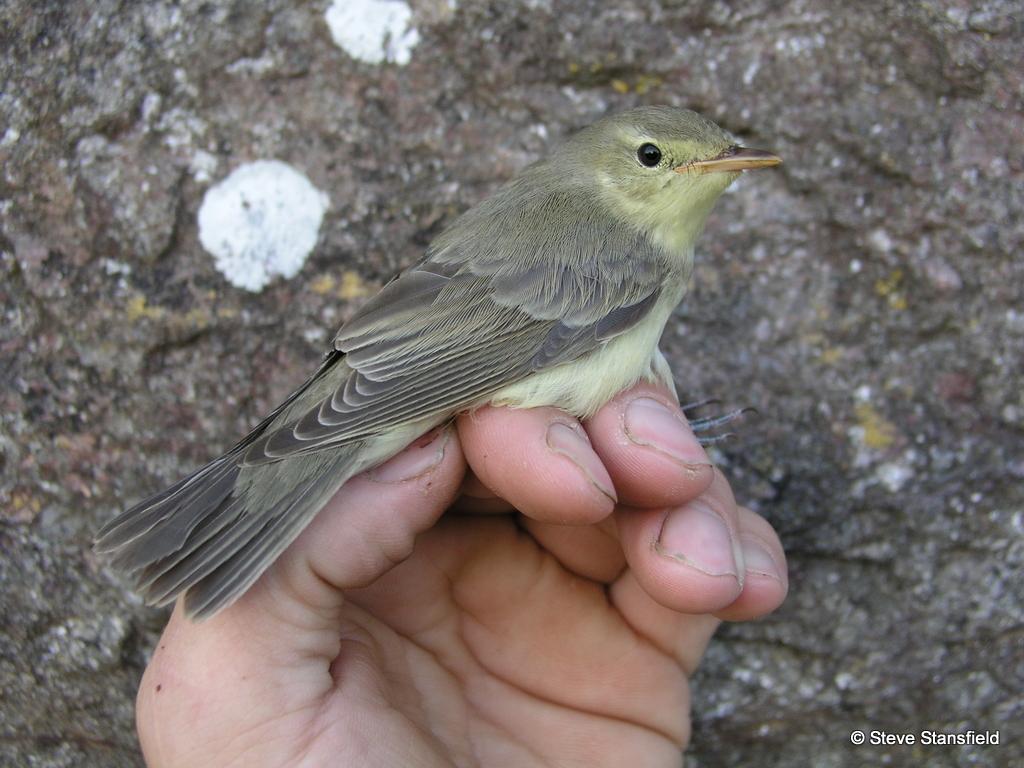
The third
Melodious Warbler of the year trapped in the New Plantation midday provided a bit of excitement on a day that was otherwise very quiet. After being ringed and released at Cristin, the Melodious Warbler showed reasonably well in the damson and willow bushes in the back garden.
On the rest of the bird front, seven
Grey Wagtails and 12
alba Wagtails passed overhead, a
Reed Warbler was seen in Ty-Pellaf Withy and a
Collared Dove flew around the lowlands. A single
Common Sandpiper and
Whimbrel were present around the Narrows.
Melodious Warbler- the third of the year
The Reed Warbler in Ty-Pellaf withy was most likely to be the same bird that has been seen on and off for two weeks now
Some smart-looking Wheatears are passing through now
Stonechat
Setaceous Hebrew Character
And now for a Hippo Photo Fest- by Steve
On Bardsey we are very fortunate to get our fair share of Hippolais Warblers. Today we trapped our third individual of the year. We have, as yet had no Icterines this year.
Today's Melodious was one of the first I have seen in a few years that had genuine fleshy tones to the legs. As a result of this I thought I would trawl through some of my images and share them with you as a brief ID post.
Some of the Melodious Warblers on here were initially identified incorrectly by observers who had, at the time, limited or no experience of the species pair; their ID was been based on the fact that the legs of the birds appear to be blue, and if you read the field guides, Melodious are supposed to be fleshy brown. Today's bird was, well sort of fleshy, but we have had many other with good blue legs.
I will point out key features on each bird in the photo with captions below the image (and apologise if it becomes repetitive). You will see that there are the usual structural differences in wing length and bulk of Icterine, compared to the slighter Melodious.
So lets start with some shots of todays bird and then work back through time (note the phot quality becomes poorer...in the main!)
Nice yellow face and little if any supercillium. (Fresh autumn juvenile)
Very short Primary extension. Note the general brownish tones to the upperparts, compare with the powdery grey of Icterine later. Note here lack of fringing to secondaries and pale tips to primaries. (Fresh autumn juvenile)
Even here the upperparts looking brown. Note how small the bird looks. (Fresh autumn juvenile)
Here we can see the pale flesh tones in the legs in both these shots in today's bird. (Fresh autumn juvenile)
Note the lack of Supercilium behind the eye on today's Melodious. (Fresh autumn juvenile)
Note here the big strong and powerful steely blue feet and legs. A flick of a supercilium behind the eye and greyish wash to the upperparts. (Fresh autumn juvenile)
The long primaries are clearly visible here. Also note the fresh white fringes to the primaries which are often shown on young Icterines, but seldom on Melodious. Also a hint of a supercilium here. (see todays bird) and blue feet. (Fresh autumn juvenile)
Even in thick cover the wing panel on a fresh Icterine is obvious. (Fresh autumn juvenile)
Note size difference between Icterine and Willow Warbler above. Icterine is much larger. (Fresh autumn juvenile)
And Melodious and Willow Warbler above. Not quite as large and noticeable in the hand.
Also note the brownish colour of the Melodious compared to the greyish cast of the Icterine above. (Fresh autumn juvenile)
Biometrics - the boring stuff!
The wing length on Icterine Warbler is 73 to 82mm and on Melodious Warbler it is 62-71mm (Svennson, 1992).
Of the 50 or so Icterine Warblers I have handled over the past 22 years most have had wings of 76-80mm, whereas the 22 Melodious I have trapped have had wings of about 64-68mm; so I have never trapped and tiny Icterines nor large Melodious. Willow Warblers have wings of 64-73mm
This adult Melodious was initially identified as an Icterine based on its blue legs and feet and an apparent wing panel. (worn autumn adult - see same bird later)
The bright adult Melodious trapped this spring had both blue legs and white pale fringes to the secondaries, but general appearance (colour) , size and primary extension clinched ID. (this bird was initially identified in flight!) (Spring adult)
Note the short primary extension on this Melodious back on, it also lacks the silvery panel of Icterine. Its feet are blue grey. (Fresh autumn juvenile)
The same bird front on showing quite blue but weak legs. also note lack of supercillium. (Fresh autumn juvenile)
Icterine wing panels and flight feathers
This shot is burnt out, but you can see a clear wing panel formed by the pale-fringed secondaries. Also the tertials are fringed white as are the primary tips. (Fresh autumn juvenile)
Another bird showing all the features mentioned in the last caption (Fresh autumn juvenile)
And another (Fresh autumn juvenile)
The wing panel on this bird is slightly subdued, but still there. note the pale primary tips too. (Fresh autumn juvenile)
Slightly more obvious here (Fresh autumn juvenile)
Note how long the wings are and the pale fringing and tips (Fresh autumn jevenile)
A good strong panel, long wings and chunky blue legs (worn adult in spring)
Good panel and long wings, but no pale tips realy as they have worn off (worn adult in spring)
Now note the amount (or complete lack of) panel and flight feather markings on these Melodious
This is the same worn adult Melodious pictured above with blue legs that caused some confusion with less experienced observers. This bird has some fringing to the tertials and three new secondaries, which created an apparent panel, but nothing like that of an Icterine. (worn adult in autumn)
Another bird with a little fringing to the primaries and secondaries, but again not a lot. (Fresh, but slightly worn juvenile in autumn)
This very fresh juvenile (earlier this autumn) could possibly cause confusion for the less experienced observer as it shows a bit of fringing on the wing (and it did look like it had a pale diffuse panel in the field), it had blue legs, but it was very small and short winged which was enough to make ID straight forward even before it was trapped.
This bird shows little of no marking on the wings and is very straightforward. (Fresh autumn juvenile)
And another lacking pale tips to primaries (Fresh autumn juvenile).
.........and now for something completely different!
In Late August 2005 (31st) I had trapped a Melodious WArbler in the morning. Later in the day I went to the south end of the island and saw for about two seconds a hippo at a range of 30 metres that I was certain was a Booted Warbler.....then I find myself looking at a Melodious Warbler seconds later without a ring on. Was it the light? Was I mad? or just crazy, there were two hippos together and was was a milky tea colour? Now that's me just being mad! I stayed with the melodious for a while taking notes on it as it was a little skulky, but I kept going back to the two second view of 'it' when I first found it. This was wrong, the bird was creamy and tea coloured not yellow. OK leave the melodious, they're common. Find this other thing, probably just a Chiffchaf, cant be a Booted, that's just MAD! An hour late I saw again at great distance and very briefly my quarry, it was not a Chiffer, nor a Melody, it has to be a Booted or Sykes type thing.

My first views after an hour of searching, in the open but distant.
I managed to creep through the gorse to get closer (ouch!), but it was worth it!
I got on the radio and called for backup (just like on the police shows on TV!!). Soon a mist net and two poles were on their way (along with an Assistant Warden and other interested parties). By now I had managed to get closer and decided it was a Booted and it needed to be trapped.
Eventually, views were good and in the open!
It eventually gave is self up.....what a releif! what a day, two Melodious and a Booted Warbler (and two Wrynecsk whils trying to find the Booted too!!!)
Cute, what more can one say?!!
Note the very short primary projection, colour and blunt stubby bill. This stubbyness and 'less spikey look' amongst other features were enough for the bird to be accepted as a Booted rather than a Sykes.